
Climate Finance and its Role in Climate Change Adaptation in Cameroon
-
Mukete Beckline


Center for Forests and Climate Change, Tiko, Cameroon
Kimeng HiltonDepartment of Development Studies, Pan African Institute for Development West Africa, Buea, Cameroon
Ngoe MuketeHigher Institute of Agriculture, Wood, Water and the Environment, University of Bertoua, Bertoua, Cameroon
Nanyongo AgnesDepartment of Development Studies, Pan African Institute for Development West Africa, Buea, Cameroon
Mukete TahleRefugee Welfare Association Cameroon, Bamenda, Cameroon
Joseph UleRefugee Welfare Association Cameroon, Bamenda, Cameroon
Vincent KangDepartment of Accounting, University of Buea, Buea, Cameroon
Kirensky MbiDepartment of Environmental Sciences, University of Buea, Buea, Cameroon
By providing the necessary financial resources to address the ensuing climate-related impacts, climate finance is fundamental in supporting sustainable livelihoods across Cameroon. As local communities struggle to adapt in the wake of climate vagaries, these funds are essential for the promotion of sustainable development, poverty reduction, and access to healthcare. This study examines climate finance and its impact on climate change adaptation and mitigation in Cameroon. To obtain this objective, a broad review of published scientific information was performed using Semantic Scholar, ResearchGate, Google Scholar, and Web of Science. The study observed that in Cameroon, although climate finance supports and promotes initiatives that focus on sustainable agriculture, reforestation, forest conservation, renewable energy, and the development of climate-smart infrastructure, several challenges persist that impede the efficient and equitable implementation of climate change initiatives. Thus, if adequate and proper financing is enforced and local communities are involved in financial management and implementation, climate finance can effectively address climate-induced threats.
INTRODUCTION
Often known as the change in a specific region’s mean weather conditions with regards to a specific period, the impacts of climate change across the globe are challenging1. Across several regions of the world, these mean weather conditions are often experienced in various forms, particularly severe weather vagaries.
Depending on the region in question, these weather vagaries may include an increase in temperatures, heavy and intermittent rains, a drop-in surface albedo, and groundwater levels2,3. As such, these weather vagaries usually spiral into floods, low agricultural yields, droughts, poor soils, as well as diseases and pests4.
For the past six decades, rainfall trends have been dropping because of terrestrial and maritime interactions in Africa. For instance, drops of about 40% between 1968 and 1990 with an increase in the variation of interannual rainfall in the 1970s, have been documented5-7. These rainfall variations have been accompanied by recurrent droughts, temperature hikes, heat waves, intermittent rainfall, and poor rainfall distribution8.
According to Giannini et al.9 and Nébié et al.10, climate variations have given rise to extreme rainfall scenarios that have rippled into unprecedented famines due to crop damage and environmental degradation across several regions of Africa. These zones have also experienced falling yields in agricultural products and hikes in the price of staple food crops, with consequences for agriculture-dependent households7. For example, in Togo11, found mean annual temperatures to be driven by evapotranspiration rates around the country. Elsewhere, in the Abeshege Woreda Region of Ethiopia, it was12 found that most farmers had observed an increase in local temperatures with a decrease in rainfall trends.
Similarly, due to high population pressure, the average farmland per household in the Sudano-Sahelian Zone of North Cameroon was found to have dropped from 0.3 in 1995 to 0.2 in 202013. In the Southwest Region of Cameroon, a study by Beckline et al.14 observed that an adjustment in sowing dates, adoption of alternative livelihood strategies or a change in cropping patterns did not exclude households from experiencing the impacts of climate vagaries. Meanwhile, around the Mandara Mountains of Northwest Cameroon and Northeast Nigeria, demographic saturation and land scarcity have spiraled over into inter-village conflicts, particularly between herders/grazers and farmers, as well as the overexploitation of wood for household consumption and artisanal logging13.
In a related study, using temporal and spatial variability of precipitation15 observed the precipitation variability to be higher for both dry season and annual levels than for the entire wet seasons of North Cameroon. Therefore, this increase in the number of annual dry days could translate into direct impacts, thereby threatening local livelihoods. Additionally16, mean annual rainfall decreased by 1.0541 mm accompanied by a mean annual temperature increase of 0.0263°C around the Mount Cameroon Region. In another study by Ngoe et al.3, regression and logit models were used to investigate farmers’ perceptions of climate vagaries around the highlands of Southwest Cameroon. Their study found that over 90% of the local population had observed changes in the number of rainy days, temperature, and rainfall patterns. Similarly, Njoya et al.17 observed adaptation to the impacts of climate change to be of utmost importance in the semi-arid extreme North Region of Cameroon, due to the high proportion of people relying on rain-fed agriculture.
This study will serve as a reference point for the various stakeholders of the climate sector, the government of Cameroon, and local communities to develop collaborative platforms that integrate climate finance into local needs, improve the management of available water resources, and enhance innovative farming practices. Therefore, the climate finance obtained from collaborative platforms would be adequately managed to support climate-resilient systems and initiatives across the country.
METHODOLOGY OF THE STUDY
Literature search: A comprehensive review of both online and offline scientific material was conducted using databases including Semantic Scholar, Mendeley, ResearchGate, Google Scholar, and Web of Science. The aim was to obtain a broad overview of climate finance in relation to climate change in Cameroon.
Keywords used in the search included:
| • | Cameroon | |
| • | Climate finance | |
| • | Climate change | |
| • | Sustainable livelihoods | |
| • | Agricultural production | |
| • | Impacts of climate variations |
The literature covered publications between 1995 and 2025 to provide a long-term perspective on the subject.
Document screening and selection: From the initial pool of over 200 documents, materials were categorized into:
| • | Cameroon-focused studies | |
| • | Climate finance | |
| • | Climate change | |
| • | Sustainable livelihoods | |
| • | Agricultural production | |
| • | Impacts of climate variations |
Exclusion criteria included studies focusing on migration, land use/land cover, household income, population dynamics, or security issues, which were considered irrelevant to the study objective.
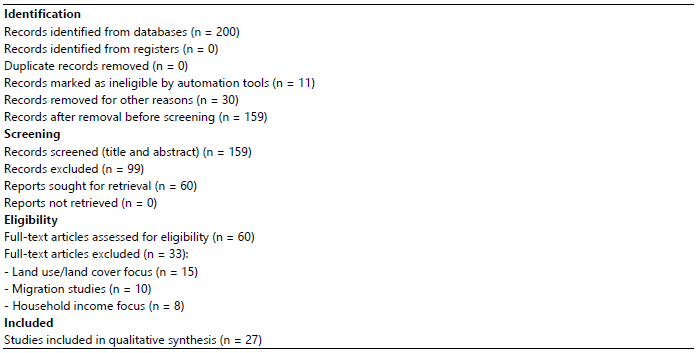
| • | After title and abstract screening, 99 records were excluded, leaving 60 full-text articles for detailed evaluation. Following full-text assessment, 33 articles were excluded based on the predefined criteria (land use/land cover = 15; migration studies = 10; household income = 8). Ultimately, 27 studies were included in the qualitative synthesis | |
| • | The study selection process is illustrated in Fig. 1 (PRISMA 2020 flow diagram) |
Data extraction and synthesis: All relevant information retrieved from the selected studies was systematically analyzed to:
| • | Assess the role of climate finance in Cameroon | |
| • | Examine its impact on climate change adaptation and mitigation | |
| • | Identify challenges and gaps in policy and implementation |
The extracted data were then organized into thematic categories in a Preferred Reporting Items for Systematic Reviews and Meta-Analyses (PRISMA 2020) flow diagram of study selection to enable a comprehensive presentation of findings, Fig. 1. It outlines the systematic review process conducted in this study. Initially, 200 records were identified, of which 99 were excluded during the screening phase because they were not relevant to the study’s focus. Following a thorough full-text review of 60 articles, a final total of 27 studies were included for qualitative synthesis18.
Key trends and patterns: Due to the recognition of climate change as a fundamental threat to the survival of man and his environment, several internationally coordinated mechanisms have been put in place stemming from regulatory to institutional19. One of such internationally coordinated mechanisms is the Climate Finance Initiative. According to the tenets of this mechanism, financial resources are to be provided by developed countries, international institutions, and private investors to support developing countries in addressing climate change and promoting sustainable development. Wherefore, these funds are intended to help countries mitigate greenhouse gas emissions, adapt to climate change impacts, and transition to low-carbon and climate-resilient economies20.
|
Therefore, financial resources raised and aimed at the mitigation or adaptation to climate change impacts are usually referred to as climate finance. These financial resources may also include public climate finance commitments by economically viable states under the Copenhagen Accord of 200920. There are currently four major sources of climate finance, including Public sources, Public intermediaries (Development Finance Institutions (DFIs), National and Multilateral Development Banks (NDBs and MDBs), and Bilateral Financial Institutions (BFIs), Private sources and private intermediaries (commercial financial institutions, venture capital, private equity and infrastructure funds).
Thus, from the very beginning, climate finance had emerged as a pivotal element in climate agreements. Here, the commitment by economically viable nations to mobilize $100 billion a year by 2020 to support less developed nations was welcomed as both a great sign of foundational trust to progress on climate action21,22. According to a study by Munguambe and Aung19, climate finance is broadly reflective of wider trends in development finance, delivered through more project-based modalities and less budget support. By providing the necessary financial resources to address the ensuing climate-related impacts, climate finance is fundamental across Cameroon.
As local communities struggle to adapt in the wake of climate vagaries, these funds are essential for the promotion of sustainable development, poverty reduction, and access to healthcare23. Through the different ministries, the Cameroon government has developed several policies, programmes, activities and strategies which directly or indirectly address climate change and associated finance. These policies and related activities, such as capacity-building, research, climate change dialogue platforms, and conferences, mostly target mitigation, with limited attention for adaptation23,24.
In Cameroon, climate finance is managed by several government institutions, including the Ministry of Environment, Protection of Nature and Sustainable Development (MINEPDED) and the National Climate Change Observatory. Aside from coordinating climate actions and ensuring alignment with national policies, these institutions also ensure the effective coordination and management of climate finance between various stakeholders25.
For instance, in Cameroon, the Green Climate Fund (GCF) provides financial support to projects and programmes that help mitigate and adapt to climate change. The GCF has supported and is currently supporting several projects across the country particularly in the Sudano-Sahelian Zone. These include the promotion of climate-smart agricultural practices, the development of renewable energy projects, and the implementation of climate-resilient infrastructure26.
Additionally, Cameroon has received financial support from other international institutions like the World Bank, African Development Bank, and bilateral partnerships with developed countries. These funds are used to implement climate change adaptation and mitigation projects, strengthen institutional capacities, and enhance the resilience of vulnerable communities25.
Furthermore, the Cameroon Green and Resilient North aimed at protecting wildlife corridors connecting the three northern protected areas of Bouba Ndjida-Faro and Benoue is being supported by the European Union. Aside from wildlife protection, this project will also scale up local climate adaptation of agro-pastoralists, fisheries, and livestock keepers.
Overall, through the provision of the necessary financial resources to address the impacts of climate change, climate finance plays a preponderant role in supporting sustainable livelihoods in Cameroon. These funds are essential in promoting sustainable development, reducing poverty, and ensuring the well-being of communities in the face of climate change challenges27.
Implications and gaps: Despite the increasing availability of climate finance mechanisms, the effectiveness of the existing mechanisms and institutions in managing and implementing climate finance in Cameroon is unclear.
Similarly, the efficient and effective allocation of climate finance for sustainable development, along with collaboration and coordination among various stakeholders, remains unclear27. Additionally, confidence in the providers of climate finance is limited, as commitments have not been fulfilled. For example, the target of USD 100 billion set during COP15 has not been achieved, and the small amount of climate finance that has actually reached the countries in need has often been exaggerated. A 2020 Oxfam study estimated that overall climate finance has been reported with an overstatement of 264%23. This study found that economically stable countries tend to significantly inflate their claims regarding activities related to climate change. Furthermore, some donors reported expenditures based on Input Sector Codes deemed eligible for climate funding, whereas others included any program impacted by weather, such as those in the water and agriculture sectors23,27.
According to a study by Lueong and Tume25, the amount of climate finance available is often insufficient relative to the scale of the needs. Many sustainable livelihood projects require substantial investment, and most often, the funds allocated are not enough to fully implement or scale up successful initiatives. This situation is compounded by the intense competition for limited international climate finance resources, which have disadvantaged Cameroon. Navigating the complex procedures and requirements of international climate finance mechanisms (Green Climate Fund and Global Environment Facility) is daunting. The lengthy and bureaucratic application processes have posed a significant barrier, particularly for local organizations with limited experience. Furthermore, some funding mechanisms have stringent eligibility criteria that have contributed to the exclusion of local Cameroonian NGOs and smaller-scale projects.
Generally, local institutions and project implementers in Cameroon lack the technical expertise required to prepare and manage high-quality climate finance proposals. This includes expertise in project design, monitoring and evaluation, and financial management. Many areas in Cameroon lack the necessary infrastructure to support sustainable livelihood projects. This includes access to reliable energy, transportation networks, and communication systems, which are essential for the successful implementation of many projects. There is thus a lack of support services such as technical assistance, training, and capacity-building programmes that are crucial for the successful implementation and sustainability of projects27.
Similarly, considering the local context and community engagement has also minimized climate finance efforts. Here, projects designed without adequate input from local communities do not align with their actual needs or priorities, leading to ineffective outcomes. In several instances, the resistance to adopting new practices and technologies due to traditional beliefs or a lack of understanding has emerged.
CONCLUSION
Although climate finance is vital for promoting sustainable development in Cameroon, numerous challenges regarding its effectiveness persist. The funds available are frequently inadequate in relation to the scale of the nation’s requirements, and there is a deficiency of crucial support services such as technical assistance and capacity-building. The systems and institutions tasked with overseeing climate finance are not operating at their best, which obstructs the realization of Cameroon’s Nationally Determined Contributions (NDCs) and Sustainable Development Goals (SDGs). To address these shortcomings, it is crucial to create a specialized national organ that can improve the management, distribution, and accountability of climate finance. Furthermore, bolstering local capacity-building initiatives and promoting community involvement are essential for the viability and enduring success of climate finance projects.
SIGNIFICANCE STATEMENT
This paper provides an analysis of climate finance and its relations to climate change adaptation dynamics in Cameroon. This study will serve as a reference point for the various stakeholders of the climate sector, the government of Cameroon, and local communities to develop collaborative platforms that integrate climate finance into local needs, improve the management of available water resources, and enhance innovative farming practices. Therefore, the climate finance obtained from collaborative platforms would be adequately managed to support climate-resilient systems and initiatives across the country.
REFERENCES
- Mukete, B., T. Lori, T. Mukete and N. Mukete, 2024. Analysis of the impacts of climate variations across semi-arid and arid regions of Southeast Africa. Asian Sci. Bull., 2: 105-111.
- Ibe, G.O., 2018. Climate variation, its impact on non timber forest products and livelihood of Ohafia people, Abia State Nigeria. Global J. Agric. Sci., 17: 91-107.
- Ngoe, M., L. Zhou, B. Mukete and M. Enjema, 2019. Perceptions of climate variability and determinants of farmers’ adaptation strategies in the highlands of Southwest Cameroon. Appl. Ecol. Environ. Res., 17: 15041-15054.
- Maganga, A.M., L. Chiwaula, P. Kambewa, 2021. Climate induced vulnerability to poverty among smallholder farmers: Evidence from Malawi. World Dev. Perspect., 21.
- Azzarri, C. and S. Signorelli, 2020. Climate and poverty in Africa South of the Sahara. World Dev., 125.
- Nicholas, A., 2023. Tropical cyclone freddy exposes major health risks in the hardest-hit Southern African countries: Lessons for climate change adaptation. Int. J. Surg.: Global Health, 6.
- Beckline, M., N. Mukete and T. Mukete, 2025. Impact of extreme weather events on agricultural production and household livelihoods in rural Malawi. Acad. Environ. Sci. Sustainability, 2.
- Hope Sr., K.R., 2009. Climate change and poverty in Africa. Int. J. Sustainable Dev. World Ecol., 16: 451-461.
- Giannini, A., P.K. Krishnamurthy, R. Cousin, N. Labidi and R.J. Choularton, 2017. Climate risk and food security in Mali: A historical perspective on adaptation. Earth's Future, 5: 144-157.
- Nébié, E.K.I., D. Ba and A. Giannini, 2021. Food security and climate shocks in Senegal: Who and where are the most vulnerable households? Global Food Secur., 29.
- Fandjinou, K., K.B. Zhang, F. Folega, B. Mukete, X.H. Yang, K. Wala and K. Akpagana, 2017. Analysis of climate variability and its relations to vegetation dynamics in Togo, Western Africa from 1984 to 2017. Appl. Ecol. Environ. Res., 17: 6761-6781.
- Dula, T., 2018. Climate variability and determinants of its adaptation strategies; the case of coffee (Coffea arabica) producer farmers at Abeshege Woreda, Ethiopia. Agric. Res. Technol., 17.
- Djongyang, N., 2022. Climate change and some adaptation measures in the Sudano-Sahelian Zone of Cameroon. E3S Web Conferences, 354.
- Beckline, M., S. Yujun, S. Ayonghe, O.L. Etta, I. Constantine and T. Richard, 2016. Adaptation of women to climate variability in the Southern slopes of the Rumpi Hills of Cameroon. Agric. For. Fish., 5: 272-279.
- Njouenwet, I., L.A.D. Tchotchou, B.O. Ayugi, G.M. Guenang, D.A. Vondou and R. Nouayou, 2022. Spatiotemporal variability, trends, and potential impacts of extreme rainfall events in the Sudano-Sahelian Region of Cameroon. Atmosphere, 13.
- Beckline, M. and V. Ntoko, 2022. Impact of micro-climate change on the forest vegetation resources of the Mount Cameroon Region. Am. J. Environ. Prot., 10: 57-66.
- Njoya, H.M., C.E. Matavel, H.A. Msangi, H.A.N. Wouapi, K. Löhr and S. Sieber, 2022. Climate change vulnerability and smallholder farmers’ adaptive responses in the semi-arid Far North Region of Cameroon. Discover Sustainability, 3.
- Haddaway, N.R., M.J. Page, C.C. Pritchard and L.A. McGuinness, 2022. PRISMA2020: An R package and Shiny app for producing PRISMA 2020-compliant flow diagrams, with interactivity for optimised digital transparency and open synthesis. Campbell Syst. Rev., 18.
- Munguambe, G.E. and N.N. Aung, 2025. Climate finance and economic resilience: The role of sustainable investments in mitigating climate change risks in developing economies. Dev. Sustainability Econ. Finance, 7.
- Peterson, L. and J. Skovgaard, 2019. Bureaucratic politics and the allocation of climate finance. World Dev., 117: 72-97.
- Chukwudum, Q.C. and S. Nadarajah, 2023. Modelling climate finance flows in Sub-Saharan Africa. Environ. Model. Assess., 28: 977-998.
- Calvet, L., G. Gianfrate and R. Uppal, 2022. The finance of climate change. J. Corporate Finance, 73.
- Ngum, F., D. Alemagi, L. Duguma, P.A. Minang, A. Kehbila and Z. Tchoundjeu, 2018. Synergizing climate change mitigation and adaptation in Cameroon. Int. J. Clim. Change Strategies Manage., 11: 118-136.
- Bele, M.Y., O. Somorin, D.J. Sonwa, J.N. Nkem and B. Locatelli, 2011. Forests and climate change adaptation policies in Cameroon. Mitigation Adapt. Strategies Global Change, 16: 369-385.
- Lueong, L.A. and S.J.P. Tume. 2024. Assessment of climate change financing mechanisms in Cameroon: A comprehensive review. J. Geogr. Environ. Earth Sci. Int., 28: 31-40.
- Birkmann, J., D. Feldmeyer, J.M. McMillan, W. Solecki and E. Totin et al., 2021. Regional clusters of vulnerability show the need for transboundary cooperation. Environ. Res. Lett., 16.
- IMF, 2024. Climate Change in Cameroon: Key Challenges and Reform Priorities. International Monetary Fund, New Hampshire, United States, ISBN: 9798400268243, Pages: 47.
How to Cite this paper?
APA-7 Style
Beckline,
M., Hilton,
K., Mukete,
N., Agnes,
N., Tahle,
M., Ule,
J., Kang,
V., Mbi,
K. (2026). Climate Finance and its Role in Climate Change Adaptation in Cameroon. Asian Science Bulletin, 4(2), 54-60. https://doi.org/10.21124/asb.2026.54.60
ACS Style
Beckline,
M.; Hilton,
K.; Mukete,
N.; Agnes,
N.; Tahle,
M.; Ule,
J.; Kang,
V.; Mbi,
K. Climate Finance and its Role in Climate Change Adaptation in Cameroon. Asian Sci. Bul 2026, 4, 54-60. https://doi.org/10.21124/asb.2026.54.60
AMA Style
Beckline
M, Hilton
K, Mukete
N, Agnes
N, Tahle
M, Ule
J, Kang
V, Mbi
K. Climate Finance and its Role in Climate Change Adaptation in Cameroon. Asian Science Bulletin. 2026; 4(2): 54-60. https://doi.org/10.21124/asb.2026.54.60
Chicago/Turabian Style
Beckline, Mukete, Kimeng Hilton, Ngoe Mukete, Nanyongo Agnes, Mukete Tahle, Joseph Ule, Vincent Kang, and Kirensky Mbi.
2026. "Climate Finance and its Role in Climate Change Adaptation in Cameroon" Asian Science Bulletin 4, no. 2: 54-60. https://doi.org/10.21124/asb.2026.54.60

This work is licensed under a Creative Commons Attribution 4.0 International License.