
Effect of Hookah Smoking on Serum Liver Enzymes and Serum Zinc Levels
-
Ferdoos Sami
Department of Chemistry, College of Science, University of Babylon, Hillah, 51001 Babylon, Iraq
Ameer Athab Alameri

Department of Pharmaceutical Chemistry, College of Pharmacy, University of Babylon, Hillah, 51001 Babylon, Iraq
Baneen Kadhim KhaleelDepartment of Pharmaceutical Chemistry, College of Pharmacy, University of Babylon, Hillah, 51001 Babylon, Iraq
Fatimah Fadhil JassimDepartment of Pharmaceutical Chemistry, College of Pharmacy, University of Babylon, Hillah, 51001 Babylon, Iraq
Dalal Hussein JassimDepartment of Pharmaceutical Chemistry, College of Pharmacy, University of Babylon, Hillah, 51001 Babylon, Iraq
| Received 14 Dec, 2025 |
Accepted 15 Feb, 2026 |
Published 31 Mar, 2026 |
Background and Objective: Hookah smoking (waterpipe) has become a widespread social habit, often misperceived as less harmful than cigarette smoking. However, it delivers high levels of toxic compounds that may impair liver function. This study aimed to evaluate the effects of hookah smoking on liver enzyme activities (AST, ALT, and ALP) and serum zinc concentration among young adult males. Materials and Methods: A cross-sectional study was conducted at the University of Babylon, Iraq. Forty healthy male participants were enrolled 30 hookah smokers and 10 non-smokers. Blood samples were collected to determine serum levels of Aspartate Transaminase (AST), Alanine Transaminase (ALT), Alkaline Phosphatase (ALP), and zinc, using spectrophotometric assays. Data were analyzed using Student’s t-test in SPSS v26, with p<0.05 considered statistically significant. Results: Hookah smokers exhibited significantly higher mean enzyme activities compared with non-smokers: AST (24.9±10.7 vs. 13.3±2.3 IU/L; p<0.001), ALT (28.1±11.9 vs. 15.3±6.4 IU/L; p<0.01), and ALP (96.3±12.2 vs. 71.8±4.66 IU/L; p<0.01). Serum zinc levels were also significantly elevated in smokers (37.22±6.99 μg/dL) compared to non-smokers (16.52±3.25 μg/dL; p<0.05). Conclusion: Hookah smoking significantly alters liver function biomarkers and zinc concentration, suggesting potential hepatocellular stress and oxidative imbalance. These findings highlight the misconception that hookah smoking is safer than cigarette use.
INTRODUCTION
Hookah, also known as shisha or waterpipe, is a tobacco smoking method gaining popularity worldwide. Although filtered through water, the smoke contains carcinogens, heavy metals, and carbon monoxide1. Each hookah session can produce up to ten times more particulate matter than cigarette smoking. The liver, responsible for detoxification and metabolism, may be particularly susceptible to oxidative and toxic stress from these compounds2,3. Elevated liver enzymes such as ALT, AST, and ALP are indicative of hepatocellular damage3,4. Moreover, smoking may influence serum trace elements, including zinc, which play vital roles in antioxidant defense and enzyme regulation5,6. In summary, while zinc itself is not directly related to hookah smoking, the overall health risks associated with hookah use are significant. It’s essential to recognize that hookah is not a safe alternative to cigarettes, and its appealing flavors can mislead users
about its harmful effects. If you’re considering hookah, be aware of the risks and make informed choices for your health7,8. Zinc is an essential trace element that plays a crucial role in various physiological processes within the human body. It is involved in immune function, wound healing, DNA synthesis, and cell division. However, when it comes to hookah (also known as waterpipe) smoking, there are several important considerations9.
Smoking constitutes a major public health concern among university students in Iraq, particularly at the University of Babylon10. The present study was designed to investigate this unhealthy behavior and to elucidate its associated health risks. Although the detrimental effects of smoking have been extensively documented worldwide, limited data are available regarding its impact on students at the University of Babylon. This research specifically examines the relationship between hookah (waterpipe) smoking and liver function by assessing alterations in hepatic enzyme biomarkers. Furthermore, the study aims to enhance awareness among young adults regarding the harmful consequences of smoking in all its forms, with particular emphasis on hookah smoking, and to underscore the importance of safeguarding both individual and public health. Accordingly, this study seeks to evaluate the effects of hookah smoking on liver enzyme markers in young adults, thereby providing scientific evidence that may contribute to the development of effective public health policies and preventive interventions.
MATERIALS AND METHODS
Study design: A cross-sectional analytical study was conducted at the University of Babylon, Iraq, from November, 2023 to January, 2024.
Participants: Forty healthy male students aged 20-30 years were enrolled, including 30 regular hookah smokers and 10 non-smokers as the control group. A total of forty male participants were enrolled and categorized into two groups: non-smokers (NS, n = 10) and hookah smokers (HS, n = 30). There was no statistically significant difference in age between the two groups (Table 1).
Ethical consideration: Ethical approval was obtained from the Ethics Committee, College of Pharmacy, University of Babylon (Approval No. 8/19/5114; 2/11/2024).
Exclusion criteria: Individuals with chronic diseases, hepatic or renal impairment, or those receiving antioxidant therapy were excluded.
Sample collection: Five milliliters of venous blood were collected, allowed to clot, centrifuged for serum separation, and stored at -20°C until analysis.
Biochemical assays: Serum Aspartate Aminotransferase (AST), Alanine Aminotransferase (ALT), Alkaline Phosphatase (ALP), and zinc concentrations were measured using standard BIOLABO colorimetric kits11.
Statistical analysis: Data were expressed as Mean±Standard Deviation and analyzed using SPSS version 26. Student’s t-test was applied, and p<0.05 was considered statistically significant.
| Table 1: | Participants’ characteristics: Non-smokers, hookah smokers | |||
| Group parameter | Nonsmokers (NS) | Hookah smokers (HS) |
| Number | 10 | 30 |
| Age (years) | 25±5 | 25±5 |
RESULTS AND DISCUSSION
Effect of hookah smoking on liver enzyme
AST concentrations in sera of nonsmokers and hookah smokers: The results in Table 2 and Fig. 1 showed that the concentrations of AST found in the sera of non-smokers (NS) were 13.3 IU/L, while in hookah smokers (CS) were 24.9 IU/L. Furthermore, the standard deviation in non-smoker, hookah smoker (2.3,10.7IU/L), respectively.
ALT (IU/L) in sera of nonsmokers, hookah smokers: The results in Table 3 and Fig. 2 show the measurement of ALT in hookah smokers and non-smokers. The present study found the mean of ALT levels in non-smokers was 15.3 I U/L, in hookah smokers was 28.1 IU/L Furthermore, the standard deviation in non-smoker hookah smokers were (6.4,11.9IU/L), respectively.

|

|
| Table 2: | AST concentration in sera (IU/L) of non-smokers and hookah smokers groups | |||
| Group | N | Mean | Std. deviation(SD) | Significant |
| NS | 10 | 13.3 | 2.3 | 0.0001* |
| HS | 30 | 24.9 | 10.7 | |
| Data are presented as Mean±Standard Deviation, NS: Non-smokers, HS: Hookah smokers, *p<0.05 indicates a statistically significant difference between groups (Student’s t-test) | ||||
| Table 3: | ALT in sera (IU/L) of Hookah smokers and non-smokers groups | |||
| Group | N | Mean | Std. deviation (SD) | Significant |
| NS | 10 | 15.3 | 6.4 | 0.001* |
| HS | 30 | 28.1 | 11.9 | |
| Data are presented as Mean±Standard Deviation, NS: Non-smokers, HS: Hookah smokers, *p<0.05 indicates a statistically significant difference between groups (Student’s t-test) | ||||
|
|
| Table 4: | ALP concentration (IU/L) in sera of hookah smokers and nonsmokers groups | |||
| Group | N | Mean | Std. deviation (SD) | Significant |
| NS | 10 | 71.8 | 4.66 | 0.01* |
| HS | 30 | 96.3 | 12.2 | |
| Data are presented as Mean±Standard Deviation, NS: Non-smokers, HS: Hookah smokers, *p<0.05 indicates a statistically significant difference between groups (Student’s t-test) | ||||
| Table 5: | Zinc concentration (μg/dL)) in sera of hookah smokers and nonsmokers groups | |||
| Group | N | Mean | Std. deviation (SD) | Significant |
| NS | 10 | 85.6 | 19.4 | 0.002* |
| HS | 30 | 43.52 | 23.3 | |
| *The mean difference is significant at the 0.05 level | ||||
ALP in sera of nonsmokers and hookah smokers: The results in Table 4 and Fig. 3 found that the level of ALP in sera of non-smoker was 71.8 IU/L, and in hookah smoker was 96.3 IU/L. Furthermore, the standard deviation in non-smoker and hookah smoker were (4.66, 12.2 IU/L), respectively.
Although hookah smoke does not come into direct contact with the liver, it incidentally affects the liver. The hookah chemicals are absorbed by the body and make their way to the liver. These chemicals cause damage to the liver cells and fibrosis. Over time, the liver becomes less effective in removing toxins from the body. This can also prevent the proper use of medicines that may be taken for a particular diseases13.
A study conducted in Iraq examined the impact of hookah (shisha) smoking on liver functions, lipid profile, and blood count in adult smokers compared to non-smokers. Here are the key findings: Liver function enzymes, specifically Aspartate Aminotransferase (AST) and Alanine Aminotransferase (ALT), were elevated in smokers compared to non-smokers. The AST levels were higher in smokers (13.6±0.347 KAU/L) compared to non-smokers (10.0±1.32 KAU/L). The ALT levels were also increased in smokers (10.5±0.446 KAU/L) compared to non-smokers. Alkaline phosphatase (ALP) levels were not significantly different between smokers and non-smokers2.
The ALP is the most routinely measured indicator for diseases of the liver bile ducts14. The AST and ALT enzymes appear regularly in the serum after hepatic cell injury, or sometimes in smaller amounts from destroyed cells. High levels of liver enzymes may indicate inflammation or damage to hepatic cells15. Most people understand clearly the effects of smoking on the heart and lungs; the abundant toxins found in cigarette tobacco lead to chronic inflammation and liver scarring, which in turn increases the risk of damage to liver cells, including diseases such as liver cancer, liver fibrosis, hepatitis B, and C16. In addition, smoking affects the function of the liver, such as alcohol and medication processes, which can increase the risk of alcoholism, as well as the overall levels of drug and alcohol tolerance17.
However, the effect of cigarette smoking and mortality in middle-aged men and found that some cigarette smoking was significantly associated with increased levels of ALP, in accordance with our findings of Wannamethee et al.18. Another study conducted by Kurtul et al.19 found that there was no statistically significant difference in serum AST levels between smokers and non-smokers, and serum ALT levels were higher in smokers than in controls. This result was in agreement with our study on ALT results only19. A potential explanation for increased levels of transaminases in smokers is the interactive effects between smoking and oxidative stress. This presumption has supported this study's significantly higher ALT levels20.
Levels of serum Zinc (Zn) in hookah smoker men compared to non-smokers: Table 5 and Fig. 4 showed that in hookah-smoking men, their age range (20-30), there was a significant elevation (p<0.05) in serum levels of Zn compared to the corresponding serum levels in non-smokers at the same age range, where serum Zinc levels were, respectively, 85.60±19.4 and 43.52±23.3.
In this study, levels of serum Zn (43.52±23.3), Table 5, in hookah-smoking men, their age range (20-30 years) were significantly elevated (p<0.05) compared to the corresponding serum levels in non-smokers (85.60±19.4). Furthermore, in the current study, serum Zn levels (42.52+23.5), Table 2, in smoker men were significantly reduced (p<0.05) compared to the corresponding serum levels in non-smokers (81.60+19.5). Results of the present study are in tune with those of other studies, where Zn level was reduced in adult smokers; moreover, researchers also reported that the hypozincemia that is often observed in adult smokers has been attributed to the acute-phase response that can be triggered by tissue damage21. Owing to the fundamental role that Zn plays in cellular metabolism, its effect is substantial in cells with a rapid turnover, such as the immune system, and is therefore said to modulate host resistance to various infections22.
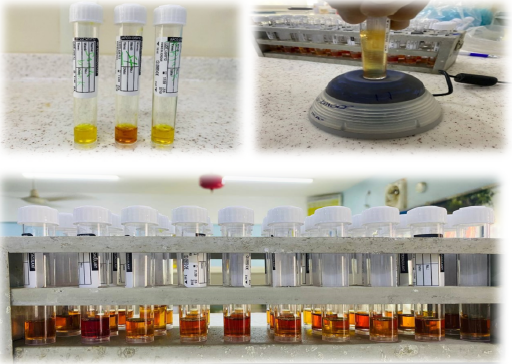
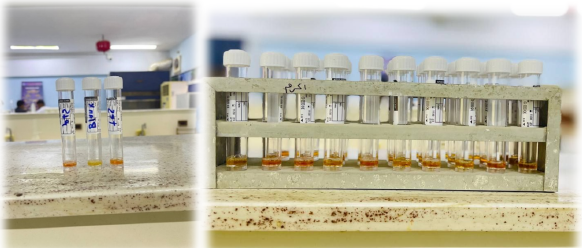
The elevated serum AST, ALT, and ALP in Picture shows the samples measured for Zinc21 Picture shows the samples measured for Zinc21 hookah smokers indicate possible hepatocellular injury or oxidative stress caused by toxic smoke components. Hookah smoke contains numerous harmful substances, including polycyclic aromatic hydrocarbons and heavy metals, which induce oxidative stress and inflammation. The observed increase in serum zinc may reflect a compensatory antioxidant response or altered trace element homeostasis. These findings align with previous studies linking tobacco exposure with hepatic dysfunction and trace metal imbalance.
CONCLUSION
Hookah smoking was associated with significant elevations in serum liver enzymes and zinc levels, indicating hepatic stress and potential metabolic imbalance. These alterations suggest that regular hookah use may compromise liver function in young adults. The findings challenge the common perception of hookah smoking as a safer alternative to cigarettes. Overall, hookah smoking represents an underrecognized risk factor for liver dysfunction.
SIGNIFICANCE STATEMENT
This study provides evidence that hookah smoking significantly alters liver enzyme activities and serum zinc levels in young adult males, reflecting early hepatic stress. By highlighting biochemical disturbances associated with waterpipe use, the findings address a critical knowledge gap regarding its health risks. The results emphasize the need for public health strategies to counter misconceptions about hookah safety and to promote awareness of its potential metabolic and hepatic consequences.
REFERENCES
- Qasim, H., A.B. Alarabi, K.H. Alzoubi, Z.A. Karim, F.Z. Alshbool and F.T. Khasawneh, 2019. The effects of hookah/waterpipe smoking on general health and the cardiovascular system. Environ. Health Preventive Med., 24.
- Yaseen, M., S. Alkubaisy and M.M. Saleh, 2021. Effects of hookah smoking on liver functions, lipid profile, and adult blood count. Biomedicine, 41: 763-767.
- El-Azab, G., E. Elkhouly, R. Abouyoussef and H. Nagdy, 2026. Smoking and liver diseases: An updated review of pathogenesis, progression, and therapeutic implications. Clin. Exp. Med., 26.
- El-Zaatari, Z.M., H.A. Chami and G.S. Zaatari, 2015. Health effects associated with waterpipe smoking. Tob. Control, 24: i31-i43.
- Badran, M. and I. Laher, 2020. Waterpipe (shisha, hookah) smoking, oxidative stress and hidden disease potential. Redox Biol., 34.
- Jubair, A.A., 2024. The effect of cigarette smoking on the functions of the liver, kidneys, and blood electrolytes. Eur. J. Res. Dev. Sustainability, 5: 23-28.
- Mohammed, F., E. Zangana and K. Abdoulrahman, 2025. Comparative analysis of heavy metal exposure and liver enzyme levels in hookah and cigarette smokers. Acad. J. Int. Univ. Erbil, 2: 510-518.
- Murali, U., R. Muthuvel, Y. Min and G.K. Subbaraj, 2026. Inflammation and Oxidative Stress: Common Pathways in Diabetes and Cancer. In: Diabetes and Cancer: Association, Mechanism, and Therapeutic Implications, Noor, R. (Ed.), Springer Nature, Singapore, ISBN: 978-981-95-5651-9, pp: 41-65.
- Chasapis, C.T., P.S.A. Ntoupa, C.A. Spiliopoulou and M.E. Stefanidou, 2020. Recent aspects of the effects of zinc on human health. Arch. Toxicol., 94: 1443-1460.
- Salman, O.D., H.A. Al-Hussaniy, M.A. Abdmahdi and S.K. Ibrahim, 2025. Assessment of some biochemical markers in electronic nicotine device smokers in Diyala province. Pharmacia, 72.
- Kind, P.R.N. and E.J. King, 1954. Estimation of plasma phosphatase by determination of hydrolysed phenol with amino-antipyrine. J. Clin. Pathol., 7: 322-326.
- Reitman, S. and S. Frankel, 1957. A colorimetric method for the determination of serum glutamic oxalacetic and glutamic pyruvic transaminases. Am. J. Clin. Pathol., 28: 56-63.
- Harris, J., D. Best, L.H. Man, S. Welch, M. Gossop and J. Strang, 2000. Changes in cigarette smoking among alcohol and drug misusers during inpatient detoxification. Addict. Biol., 5: 443-450.
- Woreta, T.A. and S.A. Alqahtani, 2014. Evaluation of abnormal liver tests. Med. Clin. N. Am., 98: 1-16.
- Raja, M.M.M., A. Raja, M.M. Imran, A.M.I. Santha and K. Devasena, 2011. Enzymes application in diagnostic prospects. Biotechnology, 10: 51-59.
- Farrell, G.C. and C.Z. Larter, 2006. Nonalcoholic fatty liver disease: From steatosis to cirrhosis. Hepatology, 43: S99-S112.
- >Jang, E.S., S.H. Jeong, S.H. Hwang, H.Y. Kim and S.Y. Ahn et al., 2012. Effects of coffee, smoking, and alcohol on liver function tests: A comprehensive cross-sectional study. BMC Gastroenterol., 12.
- Wannamethee, S.G., A.F. Lever, A.G. Shaper and P.H. Whincup, 1997. Serum potassium, cigarette smoking, and mortality in middle-aged men. Am. J. Epidemiol., 145: 598-606.
- Kurtul, N., M.Y. Cil and E. Bakan, 2004. The effects of alcohol and smoking on serum, saliva, and urine sialic acid levels. Saudi Med. J., 25: 1839-1844.
- Abudal Kadhum, Z.I., 2021. Comparison of some kidney and liver function tests between current and former Iraqi cigarettes or arghila smokers. Syst. Rev. Pharm., 12: 179-183.
- Kim, S.H., J.S. Kim, H.S. Shin and C.L. Keen, 2003. Influence of smoking on markers of oxidative stress and serum mineral concentrations in teenage girls in Korea. Nutrition, 19: 290-293.
- Milnerowicz, H., M. Ściskalskaand M. Dul, 2015. Pro-inflammatory effects of metals in persons and animals exposed to tobacco smoke. J. Trace Elem. Med. Biol., 29: 1-10.
How to Cite this paper?
APA-7 Style
Sami,
F., Alameri,
A.A., Khaleel,
B.K., Jassim,
F.F., Jassim,
D.H. (2026). Effect of Hookah Smoking on Serum Liver Enzymes and Serum Zinc Levels. Asian Science Bulletin, 4(1), 24-30. https://doi.org/10.21124/asb.2026.24.30
ACS Style
Sami,
F.; Alameri,
A.A.; Khaleel,
B.K.; Jassim,
F.F.; Jassim,
D.H. Effect of Hookah Smoking on Serum Liver Enzymes and Serum Zinc Levels. Asian Sci. Bul 2026, 4, 24-30. https://doi.org/10.21124/asb.2026.24.30
AMA Style
Sami
F, Alameri
AA, Khaleel
BK, Jassim
FF, Jassim
DH. Effect of Hookah Smoking on Serum Liver Enzymes and Serum Zinc Levels. Asian Science Bulletin. 2026; 4(1): 24-30. https://doi.org/10.21124/asb.2026.24.30
Chicago/Turabian Style
Sami, Ferdoos, Ameer Athab Alameri, Baneen Kadhim Khaleel, Fatimah Fadhil Jassim, and Dalal Hussein Jassim.
2026. "Effect of Hookah Smoking on Serum Liver Enzymes and Serum Zinc Levels" Asian Science Bulletin 4, no. 1: 24-30. https://doi.org/10.21124/asb.2026.24.30

This work is licensed under a Creative Commons Attribution 4.0 International License.