
Awareness, Acceptance, and Usage of Natural Insecticides among Grain Producers and Sellers in Nigeria: A Cross-Sectional Study
-
Evangeline Tochi Oparaocha
Departments of Public Health, Federal University of Technology, Owerri, Nigeria
Godswill Ugochukwu EkelemeDepartments of Public Health, Federal University of Technology, Owerri, Nigeria
Precious Okechukwu EteikeDepartments of Obstetrics and Gynaecology, Federal Teaching Hospital, Owerri, Nigeria
Uche ChukwuochaDepartments of Public Health, Federal University of Technology, Owerri, Nigeria
Onwuka Chigozie Divine

Department of Animal and Environmental Biology, Imo State University, Owerri, Nigeria
| Received 17 Apr, 2026 |
Accepted 05 Aug, 2026 |
Published 31 Dec, 2026 |
Background and Objective: Post-harvest insect infestation is a major cause of grain losses in Nigeria, where cowpea and maize are critical to food security and rural livelihoods. While synthetic insecticides are widely used, unsafe practices have led to excessive pesticide residues and increased health risks. Botanical insecticides offer a safer, environmentally sustainable alternative, but their adoption remains inconsistent. This study assessed awareness, acceptance, and use of natural insecticides among grain producers and sellers in Nigeria and identified factors influencing their adoption. Materials and Methods: A convergent mixed-methods cross-sectional study was conducted in Northern Nigeria, Enugu State, and Owerri (Imo State). The quantitative component involved 100 purposively selected grain value-chain actors using interviewer-administered questionnaires. Descriptive statistics and multivariable logistic regression identified predictors of use. The qualitative component included focus group discussions and in-depth interviews with 30 participants. Data were analyzed in SPSS v27 using descriptive statistics and logistic regression at p<0.05, with results reported as aORs and 95% CIs. Results: Awareness of natural insecticides was reported by 64% of respondents, while 48% reported current use. Over half (52%) expressed interest in training. Key barriers included doubts about effectiveness (60%) and limited knowledge (52%). Female respondents were less likely to use natural insecticides than males (aOR = 0.37; 95% CI: 0.14-0.97; p = 0.042). Qualitative findings showed preventive chemical fumigation in Northern Nigeria, reactive chemical use among Eastern retailers, and reliance on traditional non-chemical methods among Eastern cowpea producers. Conclusion: Despite moderate awareness, adoption of natural insecticides remains limited. Targeted training, improved regulatory oversight, and validation of botanical alternatives are needed to promote safer and sustainable grain storage practices.
INTRODUCTION
Grains such as cowpea (Vigna unguiculata), brown beans, iron beans, and maize (Zea mays) are central to food security, nutrition, and livelihoods in Nigeria. Nigeria is the world’s largest producer of cowpea and a leading producer of maize in Sub-Saharan Africa, with these grains serving as staple foods and key income sources for rural households1,2. Despite increased production, post-harvest losses due to insect infestation remain substantial, with estimates ranging from 20 to 50% depending on storage duration, pest pressure, and storage conditions1,3. Such losses undermine food availability, reduce farmers’ incomes, and exacerbate household food insecurity.
To mitigate post-harvest losses, synthetic insecticides and fumigants, particularly phosphine and organophosphates, are widely used at farm and market levels4. However, improper practices such as overdosing, repeated applications, mixing of formulations, and failure to observe safety intervals are commonly reported in low- and middle-income countries, including Nigeria4,5. Studies conducted in Nigerian grain markets have documented pesticide residues exceeding maximum residue limits, raising serious concerns about food safety, consumer exposure, and occupational health risks among grain sellers6-8. Acute and chronic health effects linked to pesticide exposure include respiratory symptoms, neurological disorders, and endocrine disruption9.
Natural insecticides, also known as botanical insecticides, are derived from plant-based materials such as neem (Azadirachtaindica), pepper (Capsicum spp.), garlic (Allium sativum), essential oils, and wood ash. These products are biodegradable, locally available, environmentally friendly, and generally less toxic to humans compared with synthetic chemicals10,11. Experimental and field studies have demonstrated their effectiveness against major storage pests, including Callosobruchusmaculatus, Sitophilus species, and Tribolium castaneum12-14. Their use aligns with the principles of integrated pest management and global efforts to reduce dependence on hazardous chemical pesticides10,15.
Despite these advantages, the adoption of natural insecticides in real-world storage systems remains inconsistent. Barriers include limited awareness, lack of standardized formulations, perceptions of reduced efficacy compared with synthetic insecticides, and market-driven incentives that prioritise rapid pest control11,15. Grain sellers face strong economic pressure to preserve grain appearance during prolonged storage, which may discourage adoption of practices perceived as slower acting16. Most existing studies focus on laboratory efficacy rather than end-user behaviour in market settings12,13. Understanding awareness and acceptance of natural insecticides among grain sellers is, therefore, critical for designing effective interventions that integrate agricultural productivity, food safety, and public health goals. This study addresses this gap by assessing awareness, practices, and acceptance of natural insecticides among selected Nigerian grain sellers, and by identifying factors influencing their adoption.
MATERIALS AND METHODS
Study design: This study employed a convergent mixed-methods cross-sectional design, integrating quantitative and qualitative approaches to assess awareness, acceptance, and use of natural insecticides among major grain dealers in Nigeria. The quantitative component involved structured questionnaires administered to grain value-chain actors, while the qualitative component consisted of focus group discussions (FGDs) and in-depth interviews (IDIs) conducted among producers, wholesalers, retailers, and key informants. The use of mixed methods enabled triangulation of findings and provided both measurable patterns and contextual insights into grain preservation practices.
Study setting: The study was conducted between September 2025 to February 2026 across selected grain-producing and grain-marketing regions in Nigeria, with representation from Northern Nigeria (major production hubs for beans and maize), Enugu State (South-East Nigeria), and Owerri, Imo State (South-East Nigeria). In Owerri, data were collected from two major markets: Ekeonunwa Market and Relief Market. These markets serve as major aggregation and redistribution centers for grains transported from Northern Nigeria to the South-East Region.
Study population: The study population comprised major actors within the grain value chain, including: Grain producers (farmers), major wholesalers, retail grain sellers, Extension officers, and other stakeholders involved in grain storage and preservation. Grains of interest included cowpea (Vigna unguiculata), brown beans, iron beans, and maize (Zea mays).
Eligibility criteria: Participants were eligible if they: Were actively involved in grain production, storage, wholesale, or retail marketing, had stored grains for at least one storage season, and provided informed consent. Individuals not directly involved in grain handling or storage were excluded.
Sample size and sampling technique
Quantitative component: A total of 100 respondents were recruited for the quantitative survey. Participants were selected using purposive sampling from major grain markets and production clusters in the study areas. The sample size was expanded from the initial exploratory phase to improve statistical precision and allow for multivariable analysis. Respondents included farmers, wholesalers, and retailers actively engaged in grain preservation and trade.
Qualitative component: A total of 30 participants were recruited for qualitative interviews using purposive sampling to ensure representation across different roles and regions.
Participants included: Producers and major grain sellers from Northern Nigeria, retailers and wholesalers in Owerri markets, Cowpea producers in Enugu State, and key informants involved in grain preservation practices. Both focus group discussions and in-depth interviews were conducted. Participants were selected based on experience, role in the grain value chain, and willingness to provide detailed insights into preservation practices.
Data collection instruments and procedures
Quantitative data collection: Quantitative data were collected using a structured, interviewer-administered questionnaire developed from a review of literature on post-harvest pest management and using botanical insecticide. The questionnaire included four sections: sociodemographic characteristics (age, sex, education, occupation, locality), awareness and acceptance of natural insecticides, current use of insecticides (natural and synthesized), and perceived barriers to adoption of natural insecticides. Research assistants were trained before data collection. Interviews were conducted face-to-face in English or local languages where necessary.
Qualitative data collection: Qualitative data were collected using semi-structured interview guides tailored to participant categories.
Focus areas included: Grain storage and preservation practices, use of chemical insecticides (e.g., Sniper, Aluminum phosphide (KUDOS), permethrin), traditional pest control methods (e.g., red pepper, sun-drying, manual removal), perceived effectiveness and safety concerns, and regional differences in storage practice. Interviews and discussions were audio-recorded with participant consent and supplemented with field notes. Interviews were conducted in English and local dialects, transcribed verbatim, and translated where necessary.
Study variables
Quantitative component: The primary outcome variable was the use of natural insecticides (Yes/No), while the independent variables included: Age group, sex, education level, occupation, locality, awareness of natural insecticides, and perceived barriers to adoption.
Data analysis
Quantitative analysis: Quantitative data were entered and analyzed using SPSS version 27. Descriptive statistics were used to summarize variables and were presented as frequencies and percentages. Bivariate analysis was conducted to assess associations between independent variables and natural insecticide use after which multivariable logistic regression was performed to identify independent predictors of natural insecticide use. Results were reported as adjusted odds ratios (aORs) with 95% confidence intervals (CIs). Statistical significance was set at p<0.05.
Qualitative analysis: Qualitative data were analyzed using thematic content analysis. Transcripts were read repeatedly to achieve familiarization. Codes were developed inductively and grouped into categories. Emerging themes were identified and compared across participant groups and regions. Findings from the qualitative analysis were triangulated with quantitative results to enhance validity and provide contextual interpretation of statistical findings.
Ethical considerations: Ethical approval was obtained from the Ethics Committee of the Department of Public Health, Federal University of Technology, Owerri, Nigeria. Participation was voluntary, and written or verbal informed consent was obtained from all participants before data collection. Confidentiality and anonymity were maintained throughout the study. Audio recordings and transcripts were stored securely and accessed only by the research team.
RESULTS
Socio-demographic characteristics of respondents: A total of 100 respondents participated in the study. Most were aged 25-34 years (36.0%), while those aged 35-44 years constituted the smallest group (8.0%). The majority were female (64.0%). Most respondents had at least a primary education, with secondary education being the most common (36.0%), followed by primary (28.0%) and no formal education (24.0%); only 12.0% had tertiary education.Wholesale grain sellers formed the largest occupational group (36.0%), followed by farmers (20.0%) and extension officers (16.0%). More than half resided in urban areas (56.0%), as illustrated in Table 1.
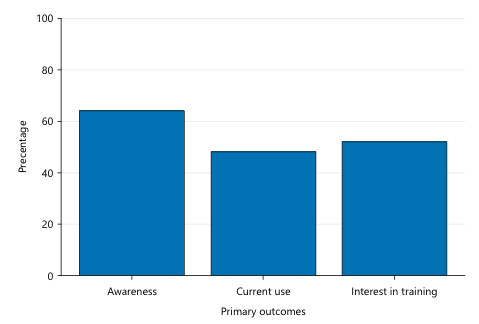
Prevalence of awareness, current use, and interest in training on natural insecticides among respondents: Among the 100 respondents surveyed, 64 (64.0%) reported being aware of natural insecticides. However, only 48 (48.0%) indicated current use of natural insecticides in practice as shown in Fig. 1. Additionally, 52 (52.0%) respondents expressed interest in receiving formal training on the preparation and application of natural insecticides.
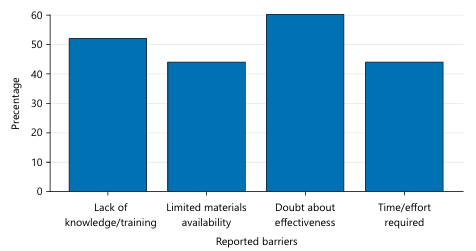
Reported barriers to adoption of natural insecticides (N = 100): The most frequently reported barrier to the adoption of natural insecticides was doubt about effectiveness, identified by 60.0% of respondents. This was followed by a lack of knowledge or training (52.0%). Barriers related to the limited availability of materials and the time/effort required for preparation and use were each reported by 44.0% of participants Fig. 2.
Multivariable logistic regression analysis: A multivariable logistic regression model was conducted to identify independent predictors of natural insecticide use. Variables included awareness, education level, locality, and gender, with reference categories defined as not aware, lower education, rural residence, and male gender. After adjustment, gender was the only significant predictor. Female respondents had significantly lower odds of using natural insecticides compared with males (aOR = 0.37; 95% CI: 0.14–0.97; p = 0.042), representing a 63% reduction in odds. Awareness showed borderline significance (aOR = 0.40; 95% CI: 0.16-1.00; p = 0.050). Awareness showed a borderline association. Education level (aOR = 1.13; 95% CI: 0.72-1.77; p = 0.599) and locality (aOR = 1.06; 95% CI: 0.43-2.60; p = 0.902) were not significantly associated with use as shown in Table 2.
|
|
| Table 1: | Sociodemographic characteristics of respondents (N = 100) | |||
| Variable | Category | n (%) |
| Age group (years) | <25 | 20 (20.0) |
| 25-34 | 36 (36.0) | |
| 35-44 | 8 (8.0) | |
| 45-54 | 20 (20.0) | |
| ≥55 | 16 (16.0) | |
| Gender | Male | 36 (36.0) |
| Female | 64 (64.0) | |
| Education level | No formal education | 24 (24.0) |
| Primary education | 28 (28.0) | |
| Secondary education | 36 (36.0) | |
| Tertiary education | 12 (12.0) | |
| Occupation | Farmer | 20 (20.0) |
| Retail grain seller | 8 (8.0) | |
| Wholesale grain seller | 36 (36.0) | |
| Extension officer | 16 (16.0) | |
| Seller | 8 (8.0) | |
| Others | 12 (12.0) | |
| Locality | Urban | 56 (56.0) |
| Rural | 44 (44.0) |
| Table 2: | Multivariable logistic regression analysis of factors associated with current use of natural insecticides | |||
| Variable (Comparison) | aOR | 95% CI | p-value |
| Awareness (Aware vs Not aware) | 0.4 | 0.16-1.00 | 0.05 |
| Education (Higher vs Lower) | 1.13 | 0.72-1.77 | 0.599 |
| Locality (Urban vs Rural) | 1.06 | 0.43-2.60 | 0.902 |
| Gender (Female vs Male) | 0.37 | 0.14-0.97 | 0.042 |
| aOR: Adjusted odds ratio, CI: Confidence interval. Reference categories: Not aware, lower education, rural residence and male gender | |||
QUALITATIVE
For the qualitative interviews, a total of 30 participants were involved, comprising producers, major wholesalers, retailers, and key informants from Northern Nigeria and Enugu State. Interviews explored grain preservation practices and the use of insect control methods. Producers and major grain sellers from Northern Nigeria reported routine use of chemical insecticides for grain preservation. Commonly mentioned products included Sniper and potassium phosphide fumigant, popularly known as KUDOS.
Participants reported fumigating their shops before stocking grains using Sniper or KUDOS. KUDOS was wrapped in small sachets and placed inside grain bags, where it gradually dissolved to prevent insect infestation during storage and transportation to other parts of the country. White beans (including iron beans) were reportedly treated with permethrin powder before distribution. Brown beans were often stored in tightly sealed nylon bags to prevent weevil infestation. These practices were described as effective in preventing post-harvest losses, particularly during long-distance transportation.
Retailers and wholesalers in major markets in Owerri, including Ekeonunwa Market and Relief Market, reported occasional use of Sniper spray on grain bags to deter pest infestation. KUDOS was sometimes introduced if visible pest attacks were observed. Retailers indicated that chemical application was often reactive rather than preventive, applied only when infestation was suspected.
In contrast, producers of cowpeas in Enugu State reported predominantly non-chemical methods of preservation. The methods used were: mixing grains with red pepper as a natural deterrent, sun-drying grains, and manual removal of infested grains. Participants emphasized that no chemical insecticides were added to cowpeas in their local production practices.
DISCUSSION
This mixed-methods study examined awareness, acceptance, and use of natural insecticides among grain producers and sellers in Nigeria within the broader context of post-harvest loss reduction and food safety. Three key patterns emerged: moderate awareness but limited adoption of natural insecticides; continued reliance on synthetic fumigants, particularly in Northern supply chains; and marked regional differences in preservation practices.
Although 64% of respondents were aware of natural insecticides, only 48% reported current use. This awareness–practice gap is consistent with earlier findings showing that knowledge of botanical pesticides does not necessarily translate into adoption11,16. Despite strong laboratory evidence supporting pesticide plants, real-world uptake is often limited by concerns about consistency, standardization, and perceived efficacy10,11. In this study, doubt about effectiveness (60%) and lack of knowledge or training (52%) were the most frequently cited barriers. A study emphasized that participatory training and demonstration trials are essential to increase user confidence in botanical alternatives17. The finding that over half of respondents expressed interest in training suggests that resistance is not absolute but linked to uncertainty and limited technical capacity.
Qualitative findings revealed routine use of dichlorvos-based and phosphide fumigants among Northern producers and wholesalers, including preventive fumigation and placement of fumigant sachets inside grain bags. This mirrors broader trends in low- and middle-income countries, where synthetic insecticides remain dominant in post-harvest protection4,5. Given that post-harvest losses in Sub-Saharan Africa can reach 20-50%1,3. traders may prioritize rapid pest control to prevent economic losses. However, this practice raises food safety concerns.
Studies in Nigeria have documented pesticide residues in grains exceeding maximum residue limits6-8. Measurable health risks associated with chronic dietary exposure to pesticide residues in staple foods7. The reported practice of placing fumigants directly into grain bags intended for consumption reinforces these concerns. The World Health Organization has highlighted both acute and chronic health effects of pesticide exposure, underscoring the public health implications of unsafe storage practices9.
Regional variation was also evident. Northern supply chains relied heavily on preventive chemical fumigation, whereas Eastern cowpea producers reported exclusive use of traditional non-chemical methods such as red pepper admixture, sun-drying, and manual sorting. The use of botanical powders and plant-based repellents has been documented in Nigeria and elsewhere in Sub-Saharan Africa12-14. While such methods may be suitable for small-scale or short-term storage, commercial supply chains that involve long-distance transport may demand faster-acting solutions, contributing to greater reliance on synthetic fumigants in Northern Regions.
Gender differences were also observed. Female respondents had significantly lower odds of using natural insecticides compared to males (aOR = 0.37; p = 0.042). Gender disparities in access to agricultural innovation and extension services have been previously reported16. suggesting that gender-sensitive interventions may be necessary to improve adoption.
Overall, the findings highlight a tension between economic imperatives to minimize post-harvest losses and the need to protect public health. FAO and WHO advocate integrated pest management (IPM) approaches that reduce pesticide risks while sustaining productivity15. Botanical insecticides align with IPM principles10, but scaling them requires supportive policy environments, commercialization pathways, and user training11.
This study’s strengths include its mixed-methods design, which enabled triangulation of quantitative and qualitative data, and its inclusion of multiple actors across regions and value-chain levels. However, purposive sampling limits generalizability, and reliance on self-reported practices may introduce bias. The absence of laboratory residue testing also limits objective assessment of exposure risk.
Strengthened regulatory enforcement, structured training programs, participatory scaling approaches, and routine residue surveillance are recommended. Supporting research and commercialization of standardized botanical formulations may also enhance confidence and adoption.
CONCLUSION
In the context of substantial post-harvest losses in Nigeria, grain traders rely heavily on synthetic fumigants to protect economic interests. However, this study reveals significant public health concerns associated with these practices and highlights moderate but incomplete adoption of natural alternatives. Bridging the gap between awareness and sustained use of botanical insecticides will require coordinated regulatory, educational, and policy interventions that integrate food safety with agricultural productivity.
SIGNIFICANCE STATEMENT
This study highlights the gap between awareness and actual use of natural insecticides among grain value-chain actors in Nigeria and provides evidence to support targeted training, policy strengthening, and promotion of safer, sustainable grain storage practices to reduce pesticide-related health risks and post-harvest losses.
REFERENCES
- FAO, 2011. Global Food Losses and Food Waste: Extent, Causes and Prevention. Food and Agriculture Organization of the United Nations, Rome, Italy, ISBN: 978-92-5-107205-9, Pages: 29.
- Fatokun, C.A., O. Boukar and S. Muranaka, 2012. Evaluation of cowpea (Vigna unguiculata (L.) Walp.) germplasm lines for tolerance to drought. Plant Genet. Resour., 10: 171-176.
- Affognon, H., C. Mutungi, P. Sanginga and C. Borgemeister, 2015. Unpacking postharvest losses in Sub-Saharan Africa: A meta-analysis. World Dev., 66: 49-68.
- Damalas, C. and S. Koutroubas, 2016. Farmers' exposure to pesticides: Toxicity types and ways of prevention. Toxics, 4.
- Williamson, S., A. Ball and P. Jules, 2008. Trends in pesticide use and drivers for safer pest management in four African countries. Crop Prot., 27: 1327-1334.
- Guntzburger, Y., J. Théolier, V. Barrere, I. Peignier, S. Godefroy and N. de Marcellis-Warin, 2020. Food industry perceptions and actions towards food fraud: Insights from a pan-Canadian study. Food Control, 113.
- Fatunsin, O.T., A.O. Oyeyiola, M.O. Moshood, L.M. Akanbi and D.E. Fadahunsi, 2020. Dietary risk assessment of organophosphate and carbamate pesticide residues in commonly eaten food crops. Sci. Afr., 8.
- Adeleye, A.O., M.B. Sosan and J.A.O. Oyekunle, 2019. Occurrence and human health risk of dichlorodiphenyltrichloroethane (DDT) and hexachlorocyclohexane (HCH) pesticide residues in commonly consumed vegetables in Southwestern Nigeria. J. Health Pollut., 9.
- Kim, K.H., Ehsanul Kabir and S.A. Jahan, 2017. Exposure to pesticides and the associated human health effects. Sci. Total Environ., 575: 525-535.
- Mossa, A.T.H., 2016. Green pesticides: Essential oils as biopesticides in insect-pest management. J. Environ. Sci. Technol., 9: 354-378.
- Isman, M.B., 2006. Botanical insecticides, deterrents, and repellents in modern agriculture and an increasingly regulated world. Annu. Rev. Entomol., 51: 45-66.
- Rajendran, S. and V. Sriranjini, 2008. Plant products as fumigants for stored-product insect control. J. Stored Prod. Res., 44: 126-135.
- Tembo, Y., A.G. Mkindi, P.A. Mkenda, N. Mpumi and R. Mwanauta et al., 2018. Pesticidal plant extracts improve yield and reduce insect pests on legume crops without harming beneficial arthropods. Front. Plant Sci., 9.
- Peña-Flores, C., A. Zapién-Martínez, G. Sánchez-Cruz, L. Reyes-Velasco and A. Segura-Salvador et al., 2025. Insecticidal and repellent activity of plant powders on the weevil (Sitophilus zeamais) in stored corn grains in a rural community of Oaxaca, Mexico. Insects, 16.
- Pretty, J. and Z.P. Bharucha, 2015. Integrated pest management for sustainable intensification of agriculture in Asia and Africa. Insects, 6: 152-182.
- Amoabeng, B.W., G.M. Gurr, C.W. Gitau and P.C. Stevenson, 2014. Cost: Benefit analysis of botanical insecticide use in cabbage: Implications for smallholder farmers in developing countries. Crop Prot., 57: 71-76.
- Belmain, S.R., B.A. Amoah, S.P. Nyirenda, J.F. Kamanula and P.C. Stevenson, 2012. Highly variable insect control efficacy of Tephrosia vogelii chemotypes. J. Agric. Food Chem., 60: 10055-10063.
How to Cite this paper?
APA-7 Style
Oparaocha,
E.T., Ekeleme,
G.U., Eteike,
P.O., Chukwuocha,
U., Divine,
O.C. (2026). Awareness, Acceptance, and Usage of Natural Insecticides among Grain Producers and Sellers in Nigeria: A Cross-Sectional Study. Asian Science Bulletin, 4(2), 61-68. https://doi.org/10.21124/asb.2026.61.68
ACS Style
Oparaocha,
E.T.; Ekeleme,
G.U.; Eteike,
P.O.; Chukwuocha,
U.; Divine,
O.C. Awareness, Acceptance, and Usage of Natural Insecticides among Grain Producers and Sellers in Nigeria: A Cross-Sectional Study. Asian Sci. Bul 2026, 4, 61-68. https://doi.org/10.21124/asb.2026.61.68
AMA Style
Oparaocha
ET, Ekeleme
GU, Eteike
PO, Chukwuocha
U, Divine
OC. Awareness, Acceptance, and Usage of Natural Insecticides among Grain Producers and Sellers in Nigeria: A Cross-Sectional Study. Asian Science Bulletin. 2026; 4(2): 61-68. https://doi.org/10.21124/asb.2026.61.68
Chicago/Turabian Style
Oparaocha, Evangeline, Tochi, Godswill Ugochukwu Ekeleme, Precious Okechukwu Eteike, Uche Chukwuocha, and Onwuka Chigozie Divine.
2026. "Awareness, Acceptance, and Usage of Natural Insecticides among Grain Producers and Sellers in Nigeria: A Cross-Sectional Study" Asian Science Bulletin 4, no. 2: 61-68. https://doi.org/10.21124/asb.2026.61.68

This work is licensed under a Creative Commons Attribution 4.0 International License.